Is our players learning? (The real price we’re paying for 4E)
Thursday, January 29, 2009 at 07:30AM
Making characters in 4E is hard. We have simple and boring formulas for much of the process, but choosing powers and keeping track of them is a chore. Rewriting them without the help of software is onerous, and something I’m trying terribly hard to avoid.
Naturally, there are quite a few solutions for this to choose from, even outside of WotC’s character builder software. That’s the good.
What’s the bad?
I’ve been struggling to figure out a useful niche of products or services I can provide now that 4E is out. This “simpler” edition has sparked a race towards automation that I think will make it difficult for those lacking tech skills to build, for example, a better, more useable blog. I won’t be writing a creature-creator or critter-templater anytime soon, even though they fit the U20 mandate of cooler creatures, easier.
Sounds like a personal problem, right? Well, it is, but I predict there will be some unintended consequences to automation for all of us.
Dumber Players, Dumber Games
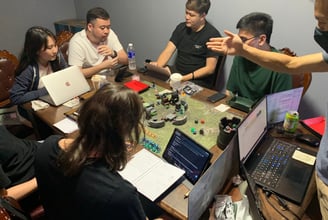
I think 4E is going to encourage less fundamental rules knowledge to enjoy the game. In itself, that sounds fantastic, both for the hobby and its players, but this will erode the roots of pen-and-paper tabletop roleplaying. No more pens, and no more paper, for instance. Laptops are at the gaming table wherever I play these days. Dice are rolled on iphones and macbooks.
Thanks to 4E’s powers system and my unwillingness to deal with it manually I will probably never be able to create a character from scratch without the aid of a rulebook, as I can with nearly any core race and class in 3.5E.
Maybe that’s just a sign of the times, and maybe it’s not even a bad thing (I’m no luddite; I love technology), but I feel rather negatively towards the move to full reliance on tech to automate a creative process, and I predict it will change the game in fundamentally negative ways.
RPG Ike |
20 Comments |
4E,
fluff/inspiration 


Reader Comments (20)
I'm seeing this a lot: "My group handles 4e in a certain way, so I assume that everyone does. I'm very upset that everyone is playing 4e in this manner!"
My group has no laptops at the gaming table. I'm the DM, and I don't even use one. The most complicated tool any of us use for character creation is a spreadsheet, and half the time it's just for formatting, with no formulas more complicated than addition. We roll real dice, even when gaming from half a country away.
We don't use power cards; we jot them down with our own brand of shorthand. Sure, we have to look them up in the book when leveling up or making characters, but I really can't think of any game besides Wushu where I don't at least glance at the manual for that sort of thing.
As for lack of core rules knowledge, I'm not sure what you mean. People know the rules relevant to their character and what they want to do. What else is there?
If your group all relies and technology and you don't like that, I offer my sympathy. But it's far from a universal trend or an inevitable one.
Disagree. I use a laptop to make characters mostly because my handwriting sucks. Writing things by hand also takes a lot of time.
I use power cards, I like them as reminders. You still have to read them and understand them in order to use them.
I think character creation is as simple as it ever was. If your players have no idea whats going on with their character sheet, that's not technology's fault it's theirs.
Back up a few steps there, Swordgleam. You’re making leaps that I’d like to address.
1. I’m not upset. Preferences for aesthetics aside, I’m not even sure it’s a bad thing that tech is replacing traditional processes. I asked a fellow player last session to roll my chain lightning damage for me on his iphone to keep the game moving. It’s cool.
2. I think there’s a great deal of evidence that it isn’t just my group (groups, actually) that are migrating towards more tech and less page-flipping. All those apps out there do, in fact, display a trend (although that’s cool that your group is sticking to the old ways. Obviously, I’m trying to do the same when it’s convenient).
3. Character creation is core rules knowledge IMO, and using a character generator ensures little absorption. Where do all those modifiers come from? How is the damage for powers worked out? Knowing a bit about your rather extensive RP background, I’m sure these things were solidified in your mind even before 4E was released, right?
A new player churning out a character with a generator would never learn where those digits come from, however. Even a player experienced with older systems (like me) could be confused (as I was, and still am, occasionally).
So, I appreciate the sympathy, but none is required. I should also point out that your rather pointed rebuttal seems based on the experiences of your group(s) alone, which is fine, but it’s far from evidence to the contrary of a universal, or inevitable, trend. :)
Tom: Disagree. I use a laptop to make characters mostly because my handwriting sucks. Writing things by hand also takes a lot of time.
I use power cards, I like them as reminders. You still have to read them and understand them in order to use them.
I'm not sure you have to understand the crunch behind them, actually. If a power gives you an attack bonus, damage, and a secondary effect, you won't necessarily know that the attack bonus is equal to 1/2 level + Int modifier, that the damage was 2[w] + Cha mod, or even what the secondary effect does (although you'd probably need to look that last one up).
Again, I don't know if that matters for most players. As a budding game designer and builder DM *I'd* certainly like to know those things.
I think character creation is as simple as it ever was. If your players have no idea whats going on with their character sheet, that's not technology's fault it's theirs.
I agree with your first statement (in fact, I never said anything to the contrary). Character creation may be as simple as ever, but it has never been simple in D&D to begin with, as far as I know.
*shrugs* I'm just troubled that, with time, I may not know much more about character creation later than I do now if I use a character generator. Absolutely that will be my fault, but my prediction has nothing to do with assigning blame.
I had to laugh at the line "The most complicated tool any of us use for character creation is a spreadsheet" since that's pretty much the cut-off line I use to decide whether a system is just too complicated to be worth it.
Heh. Nice.
I *want* to be the gamer who prefers to use the best rule for any given situation, no matter how granular or complex, but that kind of attitude is just exhausting. I see myself feeling much the same way you do in a few years, Joshua. I gravitate towards complexity, but it wears me out.
What do you play, Joshua?
If you think it's "simple as it ever was" are you talking about D&D post 2000 only? Character creation in OD&D was easier than B/X D&D was easier than AD&D was easier than d20 D&D. Not sure where 4e fits in there -- but I'm very confident that OD&D is easier than 4e D&D when it comes to creating your character. :-)
Currently I'm using Savage Worlds. Before that for about ten years I used a home brew that started its life as FUDGE, gradually getting more complicated and concrete, stopping at about roughly the same complexity as Savage Worlds (a few more stats, a few less advantages and disadvantages). If my players would sit still for it I'd really like to run something like Labyrinth Lord or one of the other retro-clones once in a while, but they really like to have their character options.
I'll admit that the 'very upset' was part hyperbole, part in reference to other posts by other people; however, you have to admit that your post isn't exactly celebrating the trend.
I think people make apps because they are fun, not necessarily because they are needed. I didn't make my 4e random character generator because of a massive demand; I made it because I wanted to make it. It doesn't mean that people need a script to randomly generate NPCs for them.
I disagree that my group can't refute a trend being universal - my group is one group, and if one group is not doing it, then not everyone is. I certainly can't argue as to whether the majority of groups are doing things one way or another. It may be that my group is the only one still doing things the old way, but I sincerely doubt that.
I'm still not sure where you're coming from with character generators. I was suspicious about a player's very high bonus to attack with his bastard sword, and he rattled off the modifiers and where they came from - this from a feat, that from an item, etc - off the top of his head. I have to admit that the majority of my d20 experience comes from 1st ed and the Iron Heroes flavor of 3.5, but the number and type of modifiers doesn't seem to have changed. I don't see how this edition requires character generators any more than any previous edition, or what gives you the idea that everyone is using them.
"Knowing a bit about your rather extensive RP background, I’m sure these things were solidified in your mind even before 4E was released, right?"
I didn't actually get the books until several months after the release, and only because Johnn was generous enough to buy them for me. I love RPGs, but I don't follow any one company or system. I thoroughly enjoy 4e, but I also thoroughly enjoy Iron Heroes, d6, and Wushu, all for different reasons. As an aside, I think much of the ferocity in the 4e vs old editions arguement comes from each side thinking they're in the minority: those who favor old editions see themselves as the last bastion of sanity against a horde of fanboys, while people who like 4e picture themselves as the few open-minded gamers left in a sea of unreasoning luddites. When everyone is against you, it's understandable to be a little more pointed in your rhetoric.
@Joshua: It's not that any of us needs a spreadsheet. It's just that when you have, say, five charisma-based skills, it's nice to have them all update when you put in a new number for your charisma modifier. It's not as if we're using excel for heavy-duty math that we couldn't handle on our own.
By the way, sorry if my replies seem pointed - it's not that I'm feeling especially passionate about the subject, but that I generally write these things while in a hurry between classes. Which is probably not the best way of going about it, but it's that or nothing. (I also tend towards tempered by intonation and body language, which is much more obvious in person. Sorry about that.)
I could see the end result being a much more positive direction. I've already seen that the control and ease over prep work that 4e brings to DMing has yielded positive results in my game prep. With less time spent building monsters or encounters, I've got more time to focus on story, RP elements, and depth, even while my overall prep time has seen a nice decrease.
As character creation becomes increasingly handled by technology, the player has to spend less time thumbing through books looking for all his modifiers or culling through long lists of feats from multiple books looking for ones he can use, then comparing them against each other, etc. You can crank out a 1st level character on WotCs Builder in 5 minutes. This leaves room for a player to focus more on development of the character of the...um...character, rather than the numbers. Spending 90 minutes statting a character then having the DM ask for half an hours worth of background and personality notes would make many players groan. After only 5 or 10 minutes on statting, that request seems much more reasonable.
With less mechanical complexity comes more room for depth and story.
Just frigging awesome comments, folks.
I'll start with a quick note to Swordgleam since I want to be certain to let you know that I appreciate your well-developed opinions and your apology. No apology necessary, I assure you! Even if you jumped on here foaming at the mouth I'd still appreciate your opinions, and if you can handle my knee-jerk gut reaction posts like the one that kicked this all off, I can handle some pointed criticism. :)
@ Stuart: Curses! I was worried someone would call me out on my limited knowledge of the previous editions! I'm sure you're probably right, but I did play a fair bit of AD&D and I seem to recall character creation being about as detailed and laborious as 3E. Feats and Proficiencies? Similar Vancian spells? THACO and BAB? It all seems pretty much equal to me.
@ Joshua: I keep hearing about Savage Worlds and Labyrinth Lord. I should probably try both sometime, but I can never find the time to focus on anything other than D&D, and I really like my character options, too. Maybe it's not for me?
Why Savage Worlds?
@ Swordgleam: Agreed, but then I never claimed anything was universal to begin with (except in the broadest sense of the evidence of a trend).
Ah, so, my guess about you and 4E was totally wrong, and I obviously can't prove anything regarding, well, anything here. I'm not really setting out to, either. I maintain that most of those people subscribing to D&D Insider or using automated tools do so because they want access to easily-customizable content. I believe those tools generally don't encourage players to learn the rules behind them, and that they may inhibit it. And I could be wrong.
These tools aren't really more necessary for 4E than they were before (frankly, I don't really care about that), but they do seem much more prevalent and well-supported this time around. 3E's character generator software was panned after just a short while, as I recall, but WotC is gearing up to support software like this for the long haul.
Finally, I'm coming around to 4E. I really just want to game in a fun way, and I'm willing to go wherever I can do that. I realize that every game has its advantages and disadvantages, and this particular post just happens to be a disadvantage I perceive with 4E. I could be wrong, but I'm pleased to test the theory with the gamer community that I have access to.
@ Thasmodious: Ah ha! Good counterpoints. I hadn't really considered that less time with your face in a book means more time and effort for that delicious fluffy stuff I enjoy so much.
However, I'm not sure I agree. Don't you think that the gamer who wants a half-hour of backstory and character development will create that anyway (just as Swordgleam and her group stick with dice and paper because they want to)? I posit that (many, most?) players who go for these tools are looking to jump in quicker and easier, not free time up for something else D&D-related.
I like where you're coming from though, Thas, and I can say that for me at least you are absolutely right. :)
Thanks again, all. I don't want to curtail a good discussion, but based on your comments I don't think my prediction has much weight... although silence is often assent, and my traffic tells me many more people are reading than are commenting.
But, as always, I could be wrong.
Hey, what do you guys think of my dice-bowl pic? Just looking at it is rather relaxing for me.
Well, I've written a quite bit about Savage Worlds on my own blog, but I think it boils down to:
*Lots of distinct character options (without going bananas with splat books)
*Fast resolution, even when lots of characters are involved
*Easy to extend and modify for specific settings
*Tactics matter, but not in a way that shuts down roleplaying (a non-combat oriented character can still help significantly in combat, and not just as a medic)
* Simple (a single book is all you need to play) but still somewhat crunchy--not one of those games where you just roll against your Awesome stat to see just how awesome you are.
I do like the dice bowl pic, though it makes me want to take out my own dice and paw through them. I probably should reorganize them for the showdown with the Big Bad this weekend, since I have my travel bag set up to play a pretty pretty princess right now. Not really the same color scheme at all.
I'm glad that it looks like I know more about games than I do! The truth is, I never even ran D&D until this fall; I only ran tri-stat before then.
I think generators will most likely be used by DMs to speed things up. Again, I can only speak for my group, and what I've noticed, but most people involved in the RPG community online seem to be DMs. One of my players reads RPT, but that's it for awareness. I think the sort of casual player who would rather use a generator than add everything up himself, would never even think to go to the WotC website to begin with.
I keep meaning to try Savage Worlds. I've heard lots of good things about it. Only two of the guys in my group share my enthusiasm for new systems, which makes things a little hard.
When it comes right down to it, I hate looking up stuff in rulebooks. It is the definition of inelegance to me. If it's something that I can hand off to a character generator, I'll go for it. It doesn't mean I understand the rules any less.
Also, not sure what point you're trying to make with "Dumber Players, Dumber Games" but it does come off as combative.
Hey Dave, welcome to U20.
I think knowing less is the definition of "dumber." I've demonstrated that I am slow at making characters with 4E, and, as I gear up to pay for the WotC character generator software, that probably won't change anytime soon because I won't be absorbing as much as I would if I were doing everything by hand.
Don't take it personally; I'm not trying to start any e-fights. I just had an idea and wanted to explore it.
Swordgleam: Yeah, you could've fooled me. I guessed that you had been playing D&D forever, but probably because a lot of that good theory applies across all systems, and you've obviously given it all quite a bit of thought.
"I think the sort of casual player who would rather use a generator than add everything up himself, would never even think to go to the WotC website to begin with. "
Very good point. You could be right. It's just unfortunate that, as you point out, the nature of the new player that could settle our mini-debate pretty much ensures he or she won't log in and let us know how they play the game and why. Ah well.
Thanks again, and good luck with your classes.
I love the dice cup pic.
I disagree with the headline, dude. Good linkbait though. :)
Players who don't know the rules are just lacking knowledge, which does not equate to high or low intelligence quotient.
My preference is to play with a group who visualize the situation, make character-based decisions, and then describe their attempts. If the players don't know the rules, cool. I can take care of that, and have done so for many years, though not so much for D&D 3&4. I just hand them the requisite dice each time and say roll. :)
In a board game, it's important for everyone to know all the rules. In RPGs, my preference is for the players to know about their characters and a few important rules-based constraints, but the rest are for the DM who wields ideas behind the curtain and matches those to gameplay via the rules.
Some of the best games I've been in were with players who hadn't rolepalyed before.
Bah. Get off my lawn.
I disagree with the headline, dude. Good linkbait though. :)
Heh. “Oh no. They’re on to me…” ;)
In a board game, it's important for everyone to know all the rules. In RPGs, my preference is for the players to know about their characters and a few important rules-based constraints, but the rest are for the DM who wields ideas behind the curtain and matches those to gameplay via the rules.
I like this explanation quite a bit.
This past weekend a friend’s girlfriend mentioned that she wouldn’t mind trying D&D sometime, but she’d like to play with a bunch of other new players so she didn’t feel stupid. I explained that there was nothing worry about—you an just tell us what you’d like to do, and we’ll tell you how to do it. Hopefully we’ll get her to play sometime soon.
Players who don't know the rules are just lacking knowledge, which does not equate to high or low intelligence quotient.
Well, of course that’s true. But.
As I design adventures for my 4E game I realize that I’m often making these grandiose plans based on my 3E knowledge, than I try to implement them in the new hotness and (sometimes) stall out during page-flipping. The same can be said for my monster design as I don’t have full exposure to all the powers and how they interact.
This will be addressed with time and work, unless I get some automated program to do the heavy lifting for me. Sure, that doesn’t really relate directly to IQ, but I was never making that argument to begin with (even if I tempted fate with my generalisation).
So, to be more accurate, for me (at least) more automation will probably mean slower rules knowledge accrual, but I think Swordgleam’s comment about the types of players who would or wouldn’t use character generators in the first place makes my original idea—that 4E players are learning fewer rules to enjoy their game—simply wrong. Finally, as J4 and I think Dave T. Game supported with their comments, that wouldn't be a bad thing.
Thanks, all.