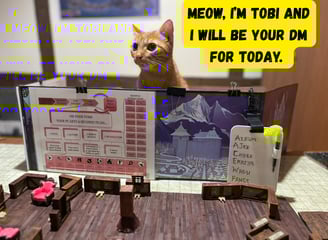
D&D is Good: Part 1
Wednesday, June 18, 2008 at 08:41PM [The "D&D is Good" series of articles is meant to provide the truth about D&D to anybody who has, unfortunately, gone to Google alone for answers about my favourite hobby. Maybe, after enough of these articles, the internet won't be such a bad place to look for decent information on the topic (there have been major improvments over the past five years). Please note that if you're unfamiliar with the game in any way, a good place to start is my What is D&D like? article.]
[Part 1 is in response to this story from Adequacy.org, posted in 2001, entitled Dungeons and Dragons: Don't Let is Happen to Your Kid. - RPG Ike]
Let's take this a step at a time. I'll start by assuring you that D&D is not a cult. It is not a religion. It is a social passtime; a hobby.
The article states "Dungeons provides its adherents with no positive moral direction whatsoever."
Simply put, this statement is false.
In over ten years of playing D&D I've learned that cooperation with other players is important, and usually necessary, to succeed. In every game I've ever played, the DM has maintained a system of checks and balances, whether the players have opted to play a fundamentally good or evil type of game. Every action in the D&D world has consequences, and more often than not, good acts are rewarded, and evil acts are punished.
The roleplaying hobby is deep and complex, which comprise its greatest appeal. Roleplaying allows you to essentially play any kind of game you, and the other players, want to play. This could include a game world where evil acts are rewarded, and it could just as easily include a game where evil is actively sought out and eliminated, anything in between those two extremes, or anything else you can imagine and build.
The bottom line is, if you're a parent concerned about D&D teaching poor values, then get involved with the game in any way you see fit, and work with the players to everyone's satisfaction. You'll find the real draw is that D&D is a lot of fun, and it would be a shame for you or your children to miss out on that when it could be such a powerful teaching tool.
D&D teaches people to work together, reinforces that actions have consequences, and usually rewards players for heroism ad selflessness.
The article states that D&D players are "extremist and unconventional."
This could be true, but I'm not sure if it's any more valid than pointing at any hobby group, workplace, sports team, or household and making the same claim. I wouldn't call any of the RP gamers I know extremist or unconventional.
Take me. I'm happily married, gamefully employed, and I really enjoy the outdoors--I walk to work every day. I wolunteer time every week with a local chapter of Big Borthers Big Sisters, as I have for over three years now. I recycle. I'm the sort of person you'd trust to take care of your cat while you're away on vacation.
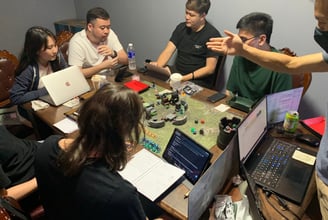
The guys who share my gaming table are some of the most responsible, likable people I know--the kind of people I spend time with away from the table. If I go around the room for one of the D&D games I'm currently playing in, I see three fathers, a husband, and me. We're all employed full-time, all socially active away from the table (we meet to play once every three weeks or so if we're lucky). In short, we're pretty okay, but even if our lifestyles don't agree with you, there's no need to blame D&D. It's a hobby. It does not rule our lives.
The article states that D&D is "authoritarian," going on to claim that there are rules "governing" every little thing, and that this hinders the teaching of any real-world skills since the dice factor into everything (which is false).
Claiming that D&D is authoritarian because it has rules is absurd. D&D can't be authoritarian; it is a game, one whose rules are mutable, and are often changed depending on who is playing. If your DM is authoritarian, I suggest speaking with him, or finding a different group to play with.
Yes, there are rules for playing D&D, lots of them, just as there are rules for playing basketball or chess. There has to be, since you are controlling a character of your design in an imaginary world where almost anything can happen. It's important to know what to do in-game if you choose to leap off a table and tackle a drunken reveller without actually hurting him (I'd have the player make a jump check to be sure they reach their target, and then have the player roll a modified, charging grapple attack, for example).
Most gamers prefer to gloss over trivial actions, like negotiating the purchase of a new horse or suit of armour (or, if you were adventurous enough to explore the links provided in the article, which are NOT in any of the published D&D rules, when an adventurer eliminates waste). The rules are there to support a game that is terribly complex. Having those rules handy helps the DM run a consistent game, which is important to keep it fun for every player. If the first player stumbled when trying to tackle the drunken reveller, you can bet that the second will try the same thing (or something equally hard to represent in game terms, like swinging off a chandelier, or throwing a chair, or running to get help), and the rules allow you to do so. Without them, there would be no game in the sense that it is most often played.
D&D has no charismatic leader. That's ridiculous, and hilarious, and a little sad to hear, all at once. I've been playing for years, and I've never met him, or heard of him until now. None of my fellow players have ever heard of this person. He does not exist.
The warning signs that your child is playing D&D are marginally less ignorant than the previous arguments, but still specious.
It's true, D&D players may indeed prefer to play D&D rather than stickball, or any number of other activities, much like any other hobbyist. It's true, D&D players may question your authority as their parents, much like any child. It's true, D&D players may have slipping grades, much like any student.
The link from D&D to any of these negative 'effects' is tenuous. If you dig a little deeper and read articles written by D&D players, you'll find there is evidence that D&D helps build many skills that will help a person succeed in school and elsewhere--you could start with "Die-Cast Ignorance" elsewhere under table manners, but if you're looking for an informed opinion from someone with strong Christian values, try M.J. Young's "Confessions of a Dungeons and Dragons Addict."
And so on. The rest of the article is not really worth responding to as I would just be repeating myself, but I hope you get the idea. D&D, as far as a decade of playing it can surmise, is a game. It's a lot of fun. It teaches reading skills, social skills, basic math skills, and organizational skills. The game is a lot of fun, and it's unfortunate that searching for D&D over google still returns articles like the one I read today.
If you are curious about D&D you owe it to yourself to speak with someone who plays the game.
Thanks for reading.
RPG Ike |
2 Comments | 


Reader Comments (2)
Good points defending our hobby. I would agree that Dungeons & Dragons the hobby has no single authoritarian leader that hands down commandments from on high, but I do think we have charismatic role models in the community. Disciples, you might call them, chosen from our ranks. For example, how about Gary Gygax? Lots of people spoke up when he died, saying how nice he was to meet in person and how they would miss him. What about Monte Cook? He sounds like a pretty nice guy. A guy you'd want to have around your table; a guy you'd want to hang out with. And Sean K. Reynolds? If his rants about game design don't count as stirring and charismatic, I'm not sure what does :)
The difference is, far from being "strict rules directing their subjects' lives in the minutest detail", Gary, Monte, and Sean preach by telling you why they think certain ways of playing are or aren't good ideas, and leave it up to each individual to examine the ideas and decide for themselves. If something makes your game more fun, use it. If not, don't. I call that critical thinking, and I'm glad our hobby encourages it.
I'd be careful about calling anyone in the gaming community (if there is such a thing) a disciple. It's a shame that detractors to the hobby latch onto selective truths and use them to "inform," but they do, and it would be easy to take your vocabulary out of context to support the gamer-cult theory. ;)
You're absolutely right about role-models, though. There are a lot of great personalities and websites out there dedicated to tabletop gaming, and what they all have in common is the desire to have fun, and to help others have fun. That's a pretty good goal.