<?xml version="1.0" encoding="UTF-8"?>
<!--Generated by Squarespace Site Server v5.11.81 (http://www.squarespace.com/) on Sat, 11 Feb 2012 14:15:22 GMT--><feed xmlns="http://www.w3.org/2005/Atom" xmlns:dc="http://purl.org/dc/elements/1.1/"><title>Table Manners - Articles from the Gaming Surface</title><subtitle>Table Manners - Articles from the Gaming Surface</subtitle><id>http://www.unnatural20.com/table-manners-latest-article/</id><link rel="alternate" type="application/xhtml+xml" href="http://www.unnatural20.com/table-manners-latest-article/"/><link rel="self" type="application/atom+xml" href="http://www.unnatural20.com/table-manners-latest-article/atom.xml"/><updated>2008-10-09T15:18:43Z</updated><generator uri="http://www.squarespace.com/" version="Squarespace Site Server v5.11.81 (http://www.squarespace.com/)">Squarespace</generator><entry><title>Fighting and Running Golems - A Guide for Players and DMs</title><id>http://www.unnatural20.com/table-manners-latest-article/2008/9/22/fighting-and-running-golems-a-guide-for-players-and-dms.html</id><link rel="alternate" type="text/html" href="http://www.unnatural20.com/table-manners-latest-article/2008/9/22/fighting-and-running-golems-a-guide-for-players-and-dms.html"/><author><name>RPG Ike</name></author><published>2008-09-22T20:56:06Z</published><updated>2008-09-22T20:56:06Z</updated><content type="html" xml:lang="en-US"><![CDATA[<P>Hello there and welcome to the first in a series of articles designed to help DMs run, and players fight, specific monsters better. This article's focus is golems, those mindless bashers that can be a handful at any level.</P>
<P>
<H3>A Quick Note About 4e Golems</H3>
<P>Golems in 4e are all elite monsters, like our very own <A href="http://www.unnatural20.com/weekly-critter-crate/4e_Lev9_burning-heart-golem.pdf">Burning Heart Golem</A>, so they're certainly tougher than your average critter, but they don't have the brick-wall immunities that they had in 3.5. Therefore, dealing with them is not much different than any other strong brute or soldier. Since their slams can keep you dazed continuously, though, and their strongest powers recharge regularly, it's probably best to take out golems as fast as possible. </P>
<P>This article focuses on, but is not limited to, the tactics and tribulations of running and fighting golems in D&amp;D 3.5. </P>
<P>
<H3>Golems</H3>
<P>Golems are hard to fight because they have few real weaknesses. They have strong attacks, overlapping defenses, and more immunities than a room full of antiviral medications. Being mindless doesn’t detract from the golem’s ability to smash PCs into pudding, either, but it does make them impossible to trick, bait, or ambush in any effective way. Still, even the mightiest golem can be reduced to its composite parts, be they gem, flesh, clay, stone, or iron, with a little bit of forethought, some quick acting, or a combination thereof.</P>
<P>
<H3>Golem Strengths&nbsp;</H3>
<ul>
<li>Golems have blanket spell-immunity, simply ignoring most magic 
<li>Golems have excellent damage reduction (traditionally DR 10/Adamantine, or better, but our own 3.5 <A href="http://www.unnatural20.com/weekly-critter-crate/burning-heart-golem-3.5.pdf">Burning Heart Golem</A> has paltry DR 10/Magic and Bludgeoning), mitigating even the most spirited sword strikes and hammer blows 
<li>Golems are mindless, so they can't be bargained with, baited, fooled, dominated, or cajoled 
<li>Golems are immune to sneak attacks and critical hits 
<li>Golems hit hard </li>
</ul>
<P>
<H3>Golem Weaknesses</H3>
<P>Golems have few real weaknesses, and a canny DM will place them in small rooms or make them a part of traps to mitigate what&nbsp;few they have. Still, each has specific vulnerabilities. If your characters can learn them your fights will be much easier.</P>
<ul>
<li>Golems are mindless (or near enough), making them predictable. Chances are very good that they will close to melee and punch away 
<li>Golems are usually slow-moving (although a 4e golem will surprise you in a very bad way every little while with its recharging golem rampage ability) 
<li>Golems have very specific weaknesses in that certain spells affect them, usually in rather debilitating ways, despite their blanket immunities. </li>
</ul>
<P>
<H3>Fighting the Golem (For Players)</H3>
<P>If possible, perform all of the following steps before entering combat with golems.</P>
<P>
<H4>1. Research your golem</H4><span>Check libraries, speak with sages, ask the locals, or just make knowledge:arcana checks (you'll need to be trained, though). Use your social skills to learn as much as possible before entering combat. Even the characters who aren't normally planners can help with this. Depending on your DM and the world you're in, you may learn a lot of valuable information. <br></span>
<P>
<H4>2. Go shopping for big-ticket items</H4>
<P>Buy, create, or steal as many Golembane Scarabs (3.5DMG Pg.266), and construct-bane (3.5DMG Pg.224) and adamantine (3.5DMG Pg. 283) weapons as you can. Depending on your campaign, this may not be many, but make it a priority to put at least one of these items in the hands of your tank (soldier) with the most staying power.</P>
<P>
<H4>3. Go shopping for small-ticket items</H4>
<P>Be sure to buy potions, scrolls, or oils that will keep your tank/soldier on his feet for longer (and if you haven't already. be sure to check out U20's basic <A href="http://www.unnatural20.com/table-manners-latest-article/">hero survival guide</A>&nbsp;entitled <EM>So you want to kill monsters and gain treasure</EM>. If you're battling burning-heart, flesh, or clay golems, focus on HP, AC, and dealing damage. If you're facing stone or iron golems, or advanced versions of the lower-level golems, focus on HP and dealing damage only, as the golem's attack bonuses will <STRONG>probably</STRONG> outpace any AC buffs you can manage. </P>
<P>(<em>Don't let&nbsp;me stop you from trying, though; my first experience with a clay golem turned a bit silly when it batted us around for a while, we ran away, we came back, we buffed each other for five straight rounds, and then we simply outlasted it in melee. It was inelegant, but it worked. ~RPG Ike</em>.)</P>
<P>
<H4>4. Revise and review&nbsp;your role in the battle</H4>
<P>Understanding your role in the party is important when fighting golems, especially since your role may change dramatically when faced with their daunting defenses. Here's a breakdown by role.</P>
<P><strong>Tank/Soldier</strong> - Be the first the golem sees, and deal damage every round you can. Grit your teeth, smash away, and hope the healers have your back. Golem ACs aren't usually very high, so this might be a great time to use two-handed Power Attacks.</P>
<P><strong>Striker/Specialist</strong> - Your role is purely support in this battle. Sorry, but chances are that you just won't have the raw power or items to damage, trip, grapple, or&nbsp; otherwise hinder a golem reliably. Instead, focus on strategic flanking, aid another actions (3.5PH Pg. 154), and be ready to drag party members out of harm's reach or to pour potions down throats. If you're Itching to get in there and swing away, be ready to take up that particular torch when your tank gets punched out.&nbsp; If the golem has friends, however, your goals should be to wipe them out as quickly as possible, especially if they are giving the golem orders.</P>
<P><strong>Controller/Artillery/Glass Cannons</strong> - If you've learned what spells affect the golem, use them mercilessly and you'll be responsible for winning the day. Even cantrips can cause serious trouble by keeping golems slowed for the entire battle, but your character won't know that unless he's researched it. If you didn't do your homework, prepare the escape routes, buff your front-liners, stay out of reach, and hinder the golem any way you can.</P>
<P><strong>Healers</strong> - Buff the tank and keep him alive. If he falls, be prepared to step into his place to bash away, or use total defense if necessary while the others get him back on his feet. When things turn sour, you are probably the one the whole party will look at to set things right.</P>
<P>
<H4>The Worst-Case Scenario</H4>
<P>You walk into the room, the doors slam shut, and the golem stomps towards you. What do you do?</P>
<P><strong>Fulfill your role as well as you can, as soon as you can.</strong></P>
<P>Being surprised by the golem just means that performing your role as given above becomes much more important. The tank needs to start taking and giving damage right this instant, the casters need to buff him up so he'll stay standing, and so he can bust through the golem's DR, and the strikers need to help wherever they can while avoiding those massive fists. A battle with a golem is usually straightforward, so stick with what you do best and you should be okay (depending on your DM).</P>
<P>
<H3>Running the Golem (For DMs)</H3>
<P>Golems have just one purpose--they punch things, so they aren't particularly difficult or rewarding to run. They can cause your players a lot of problems, or they can encourage meta-gaming and boring, ciruclar buff-fests, so there are still a few things to pay attention to when running golems.</P>
<P>
<H4>1. Give the players a chance to learn the golem's weaknesses</H4>
<P>We've provided base Knowledge:Arcana (3.5PH pg 78) DCs below alongside the information the PCs could glean, but it might be worthwhile to lower them a point or two if it will allow the PCs to act on their own, rather than the players simply looking up the creature in the MM. Remember that for every 5 points above the base DC you can reveal another useful bit of information.</P>
<P><strong>Burning-Heart Golem</strong>&nbsp;- Base DC 16</P>
<P>A magical attack that deals sonic damage causes dischord in the golem's "heart" gem, slowing* it for 2D4 rounds with no saving throw<strong>;</strong> Submerging or drenching a Burning Heart Golem in water may extinguish its heart, effectively killing it; The Quench spell (3.5PH Pg.267) extinguishes the golem's "heart" gem with no saving throw, effectively killing it.</P>
<P><strong>Flesh Golem</strong> - Base DC 19 </P>
<P>A magical attack dealing cold or fire damage slows* a flesh golem for 2d6 rounds, no save<strong>;</strong> A magical attack dealing electricity damage breaks any slow effects and heals 1 point of damage for every 3 points it would normally have dealt, no save. </P>
<P><strong>Clay Golem</strong> - Base DC 21</P>
<P>Damage dealt by a clay golem never heals naturally, and even resists magical healing<strong>;</strong> A magical attack dealing acid damage heals 1 point of damage for every 3 points it would normally have dealt, no save<strong>;</strong> The <em>Move Earth </em>spell (3.5PH Pg. 257) drives the golem back 120 ft. and deals 3d12 damage, no save<strong>;</strong> the <em>Disintegrate</em> spell (3.5PH Pg. 222) slows* the clay golem for 1d6 rounds and deals 1d12 damage, no save<strong>;</strong> The <em>Earthquake</em> spell (3.5PH Pg. 225) stops the clay golem from moving on its next turn and deals 5d12 damage, no save.</P>
<P><strong>Stone Golem</strong> - Base DC 24</P>
<P>The <em>Transmute Rock to Mud </em>spell (3.5PH Pg. 295) slows the stone golem for 2d6 rounds, no save<strong>;</strong> The <em>Stone to Flesh </em>spell (3.5PH Pg. 285) negates both the stone golem's damage reduction and magic immunity for one round, no save.</P>
<P><strong>Iron Golem</strong> - Base DC 28 </P>
<P>The iron golem can spew a cloud of poisonous gas in combat; A magical attack that deals electricity damage slows* the iron golem for 3 rounds, no save<strong>; </strong>A magical attack that deals fire damage breaks any slow effect and heals the iron golem 1 point for every 3 points of damage it would normally have dealt, no save<strong>;</strong> Rust attacks, like the <em>Rusting Grasp</em> spell (3.5PH Pg.273)&nbsp;or the attacks from a rust monster, function normally against an iron golem.</P>
<P>*<em>A slowed creature moves at half speed, suffers a -1 penalty to attacks, AC, and Reflex saves, and can only take a single move or standard action each round</em>. (3.5PH Pg. 280) </P>
<P>
<H4>2. Place your golems somewhere enclosed</H4>
<P>Golems are generally slow, and are often meant to guard a specific site. Once your players are facing golems they will definitely have the edge in mobility, so be sure to avoid flesh golems guarding wide-open forest groves, and try not to place them in vast libraries with 50-foot vaulted ceilings. A single sorceror with spider-climb or fly will make those encounters boring for everyone involved, and while you should always encourage and reward ingenuity (even if the results are sometimes at the expense of your beloved critters), you want each encounter to feel vital and exciting for your players, not just a matter of time.</P>
<P>
<H4>3. Make Golems Consistently Dumb</H4>
<P>Third-edition golems are totally mindless, 4th-edition golems are able to reason and change tactics in rudimentary ways. Every "decision" the golem makes needs to be governed by these facts or you risk alienating your players--chances are they know it's "just" an automaton. Consistency is perceived as fairness, and nothing will cause an argument quicker than forcing your players to say "Really? It hid behind the door and ambushed us? I don't buy it."</P>
<P>If you want your golems to adapt to the situation, you'd better pair them up with their creator and have him give them new commands.</P>
<P>
<H3>The Finished Product</H3>
<P>Following these steps as a player and DM will ensure that your next golem encounter will be heroic, (hopefully) not too deadly, and rewarding, plus the critter will reach its full potential while avoiding the pitfalls that can arise when stone, clay, iron, and flesh walks anew.</P>
<P>---</P>
<P>Did you find this article useful? Want to see more like it? <A href="http://www.unnatural20.com/fighting-and-running-monsters/">Vote on the critter you want to learn how to run and fight better right now</A>.</P>]]></content></entry><entry><title>7 Benefits of Running Well-Designed Monsters</title><id>http://www.unnatural20.com/table-manners-latest-article/2008/9/2/7-benefits-of-running-well-designed-monsters.html</id><link rel="alternate" type="text/html" href="http://www.unnatural20.com/table-manners-latest-article/2008/9/2/7-benefits-of-running-well-designed-monsters.html"/><author><name>RPG Ike</name></author><published>2008-09-02T23:35:00Z</published><updated>2008-09-02T23:35:00Z</updated><content type="html" xml:lang="en-US"><![CDATA[<P>While designing our own monsters, and through decades of play, we’ve learned that there are many benefits to be had by having a well-designed monster laid out in front of you during play. This article is designed to help you run your monsters easier and better by examining those benefits and teaching you how to transform the ordinary critters in any given book into extraordinarily well-designed monsters.</P>
<P><strong>1. Well-designed monsters are easier to match against your players. </strong></P>
<P>We've all been there—the battle has turned deadly for one side or the other, too soon, and reinforcements arrive to shore up the losing team. This can be a great tool to fall back on as a DM to keep players interested, motivated, and challenged, but having the right, light touch to do so without it feeling like Deus Ex Machina is hard. Players who are saved by NPC X, especially if they've never met her before now, can feel like they're less involved in the game's direction, or are sidekicks to your NPCs and plotline. Also, Players being forced to fight the same battle two or three times as you add bad guys will grow bored with the combat and be removed from the reality of your game world as the enemies seem to "respawn" before their eyes. </P>
<P>Ideally you'd never have to modify an encounter mid-fight (good luck). While this isn't the reality of running tabletop RPGs, it's helpful to be able to gauge how difficult an encounter will be for your players before play, and a well-designed monster offers you that. Well-designed monsters will let you examine, at a glance, not only their basic challenge rating, but will also let you pit their unique abilities, combat style, and behavior against that of your players. This will mean more consistent challenges for your game, and fewer reasons to step in and save one side, or the other.</P>
<P>In consideration of a monster's abilities and challenge rating, it can be helpful to visualize an encounter before it begins (preferably the night before a session). Challenge Rating aside, your party makeup might make the fight too easy, too hard, or just right. A well-designed monster will help to make that clear before you call for initiative.</P>
<P><strong>2. Well-designed monsters are more fun to run, and more fun to fight. </strong></P>
<P>Running powerful monsters is one of the great joys of being a DM. Hopefully, I don't have to tell you to imagine stomping around the battlefield as a 10-ton treant, or strafing puny PCs with your iron tail spikes as a manticore. (If you have to imagine this, try DMing as soon as you can!)</P>
<P>The problem is that sometimes the rules for trampling enemies aren't laid out very well, or worse yet, the rules for flight aren't even in the monster book you have in front of you. Many (maybe most) battles include special cases that aren't explicitly covered by the rules—for example, what if the party being trampled is wearing spiked armour? </P>
<P>Even for seasoned players and DMs, having to search for a rule elsewhere slows the game to a dead stop. Worse, page-flipping can sometimes result in discussions (which can be healthy, but they always ruin the flow), or even arguments, neither of which are as fun as resolving the action and continuing play. (The trample example above would likely have the players looking up armour spikes in the PH and the Trample special attack in the MM and DMG—three books for one rule!)</P>
<P>A well-designed monster will have all but the most basic rules at your fingertips, reducing page-flipping, discussions, and arguments, and maintaining the flow of the game. You get back to the fun quickly, if you ever left it at all. </P>
<P>If your critter has any special abilities, know the rules in advance so you can ask for the appropriate rolls and present the players with their options. A simple shorthand version of the attack form, like "Trample: (3.5DMG P.316) Move 40 feet, 1D10+12 damage, DC 20 Ref Save for half *OR* Take AoO (AC 24)" can speed up the actions on your side of the screen and will let you resolve any unforeseen issues as quickly as possible.</P>
<P><strong>3. Well-designed monsters provide much less worry about running the critter "wrong." </strong></P>
<P>A DM has a whole world to run, so it should surprise no one when he makes a mistake, forgets an important detail, or (commonly) omits relevant critter ability during combat. Hopefully we will forgive the DM his transgressions. </P>
<P>Complex critters often have much more than just deep motivations; they have multiple attacks, defences, and multi-stage spell-like abilities. Keeping it all straight is hard, but it's easy to use the "wrong" abilities, or the "right" ones poorly. No one wants to stifle creativity, but having a plan is often much more effective than something you develop off-the-cuff (and honestly, while we all enjoy a bit of successful creative play, you're more likely to make one of those aforementioned mistakes than to discover creative perfection). The most recent versions of the MM have some very basic round-by-round tactics for some critters, which is good, but it would be far better to have your plans in place well in advance of the battle, for longer battles, and for multiple situations. </P>
<P>What does your critter do when everyone makes their saving throws? Does he have a backup plan in case he can't reach the PCs? What if he needs to escape? How does he react when backed into a corner? A well-designed monster provides the answers to these questions, and more, so you're as prepared to run the critter, as the critter is to fight for its life.</P>
<P>No one expects a DM to have all these questions answered, but better for your ingenious villains to act like they've been in a battle or two, rather then being stumped at the first sign of resourcefulness from the PCs. </P>
<P>Once again, take a look at your monster ahead of time and be sure to earmark useful go-to abilities for certain situations. Then, take a look at those you've found less useful at-a-glance, and come up with uses for them. You might be surprised how helpful those "useless" abilities can be, and you'll never have to worry about playing the monster at less than its potential, which will make combat more enjoyable for you, and victories more satisfying for your players.</P>
<P><strong>4. Well-designed monsters give you practice with the rules which makes you a better GM. </strong></P>
<P>No one wants to reduce one of the most creative and varied hobbies around to repeating the same tactics, rules, and rolls again and again, but let's face it; fighters like to power attack, wizards like to fireball, and DMs employ many claws, bites, and improved grabs. It can be refreshing, and a lot of fun, to run a monster designed with a few different rules in mind, and the more exposure you have to new rules and unusual situations, the better you'll be at adjudicating and maintaining the flow of the game.</P>
<P>Looking into the critter crate at the <A href="http://www.unnatural20.com/weekly-critter-crate/" target=_blank>Verdant Reclaimer</A>, you'll see we created a very specific set of special attacks that work one right after the other to force a creature to enter the monster's square. We wanted to do this without the usual grapple checks (since grappling is common, narrowly-focused, and sometimes messy to adjudicate), and we didn't want to resort to the roper's Attach ability (which didn't logically fit with the Reclaimer's vines). So we came up with grab, drag, and smother, each of which allows the PC to use rules other than their grapple or escape artist checks to defeat the reclaimer's deadly pull. This rewards slippery characters, characters with high strength scores, characters with specific weapons and the ability to deal good damage with them, and also characters with the skill points to escape the grab, or avoid it in the first place.</P>
<P>The next time you design a monster, keep in mind a wide range skills and abilities, and don't be afraid to design whole new abilities to accommodate them. The next time you run a monster, try bending the rules in logical ways without interrupting the flow. This will keep combat varied and interesting for everyone involved.</P>
<P><strong>5. Well-designed monsters help you roleplay dynamically, offering richer stories. </strong></P>
<P>We aren't all method actors, but even the most jaded munchkin gamer enjoys it when a monster or villainous NPC acts in character (preferably while being converted to XP and treasure). Multi-dimensional characters are more interesting than cardboard cutouts, and well-designed monsters include all that information for when you want it, without forcing you to read it when you don't.</P>
<P>A well-designed monster, with the tactics, abilities, and important-but-uninteresting math bits at your fingertips, lets you focus on bringing that monster to life and maintaining flow; a key to keeping your players interested and viscerally involved in their battles. This will result not only in better, richer stories for the PCs to tell in-game as they expound on their exploits, but also in more stories that your players will bring up for years afterwards away from the table.</P>
<P>You're probably seeing a trend here, but we at U20 believe that planning is important for encounters, and a big part of encounter planning is knowing your monster well. As I've brought up in the blog a few times before, I think 4e lacks a lot of the detail that lets you really get to know your critters, which makes it harder for a DM to roleplay them dynamically. </P>
<P>Earlier editions were better, but regardless of the numbers on your core books it pays to spend a few minutes considering a monster's physical and emotional traits. This leads organically into how they sound, giving them a voice you can emulate, which leads you to act a certain way. Your players will probably react to that, and suddenly you've got a richer game.</P>
<P>You might be surprised what just a few minutes will do for you.</P>
<P><strong>6. Well-designed monsters save you session preparation time. </strong></P>
<P>The most common complaint of DMs and GMs everywhere is that it takes a long time to prepare sessions, and unfortunately, DM burnout will kill a campaign faster and deader than any TPK. How to save preparation time is the subject of much discussion. U20 believes a great place to start is with a well-designed monster.</P>
<P>We have made great strides over the past few years with the streamlined statistics blocks seen in the Monster Manual IV, and those that followed. with D&amp;D 4e, monsters have never been simpler to run in combat, but what if you want some real depth in your combat, with multi-stage tactics or special manoeuvres? What do you do if the monster's actions outside of combat are as important as those after you've rolled initiative? How can you get the crunchy and fluffy bits at the same time?</P>
<P>A well-designed monster will save you prep time by combining easy-to-read statistics and detailed, situational combat tactics (so you don't have to develop tactics of your own) with the ecology, history, and colourful bits that let you build a rich world and story around the players. And wouldn't it be nice if you had several versions of the critter to choose from to better suit your group, without having to modify it yourself?</P>
<P>Designing your own tactics is easy if you focus on the three big combat situations: before combat, when combat is going well, and when combat is going poorly. This will let you review a monster's arsenal, put together ideal tactics, and then develop an escape/contingency plan (even if it is just sprinting and screaming), all in just a few minutes. This will make the combat smoother, and the tactics and ideas you form here will likely transfer to other creatures, as well.</P>
<P><strong>7. A well-designed monster won't leave you guessing. </strong></P>
<P>A well-designed monster sets you up as a great DM with all the answers, before and during a game session. You're never left wondering how best to incorporate the monster into your campaign, and you're always ready when the players ask those questions you haven't planned for.</P>
<P>With all the monsters we have at our disposal it's a wonder we can settle on those that fit our campaigns or game styles at all. Well-designed monsters make those choices easy by including origin stories, ecologies, histories, and whatever else makes that critter breathe in the game world it's brought into.</P>
<P>Likewise, you never have to worry about having no answers to the toughest questions your players might ask. Common examples include:</P>
<P>* Can I use anything in its body to make a potion, a weapon, or to strengthen a spell?</P>
<P>* What was it doing down here? What did it eat?</P>
<P>* It must have a lair. Where does it live?</P>
<P>There are also those questions you don't want to answer directly to the players, but you'll need to know those answers as the DM.</P>
<P>* Based on its intelligence, what does it do when the environment changes? </P>
<P>* What does it do when it's hurt? When it's frightened?</P>
<P>* Is it smart enough to use magic items?</P>
<P>* Can it use tools?</P>
<P>* Will it develop tactics as a fight progresses?</P>
<P>Obviously it's a lot of work to answer all of these questions for every critter you run, but for those that are centrally important to the game you can count on needing those answers sometime.</P>
<P><strong>You should be running well-designed monsters in your game.</strong></P>
<P>So there you have it; 7 major benefits to running well-designed monsters.</P>
<P>With each iteration of the core rules we get closer to the ideal monster, but if you’re ready to reap the many benefits of truly well-designed monsters—less preparation time, fewer worries, a better, smoother, more <em>alive</em> game that will suck in your players like never before—than keep your eyes open for the launch of the Unnatural20 store later this month.</P>]]></content></entry><entry><title>The Importance of Cool Treasure in your Game</title><id>http://www.unnatural20.com/table-manners-latest-article/2008/8/31/the-importance-of-cool-treasure-in-your-game.html</id><link rel="alternate" type="text/html" href="http://www.unnatural20.com/table-manners-latest-article/2008/8/31/the-importance-of-cool-treasure-in-your-game.html"/><author><name>RPG Ike</name></author><published>2008-08-31T23:49:29Z</published><updated>2008-08-31T23:49:29Z</updated><content type="html" xml:lang="en-US"><![CDATA[<P>Treasure is a key ingredient for a successful D&amp;D game, but like the setting in a screenplay, few storytellers (DMs) give it the attention it deserves. If you treat your treasure like another tool on your belt, you can get many benefits with minimal effort, and that's a big win as a time-strapped DM. This article will show you how to get the most out of your treasure by looking at it like a tool, rather than a random result or a gold piece value.</P><br>
<P><strong>
<H4>What constitutes cool treasure?</H4></strong>
<P>The answer depends on who you are asking, but for U20, cool treasure is the stuff that's different from what you're used to seeing; it’s unique in some way. Cool abilities, interesting backstories, or an unusual look are all ways to make the treasure in your game cooler. A sword is boring. The sword of the nameless assassin, though—a blade that kills every time it is drawn from its jewelled scabbard—now that's cool.</P><br>
<P><strong>
<H4>What's in it for the players?</H4></strong>
<P>There are many player benefits to having cool treasure in your game. </P>
<P><strong>Vivid Encounters and Cooler Stories </strong></P>
<P>Players with cool treasure will draw attention to their cool items and weapons as they fight and roleplay. Consider the following. </P>
<P>"I draw my weapon as a free action while moving and axe him a question. I can get all the way there thanks to my magic boots." </P>
<P>It's pretty clear what's happening in that scene, but it's boring to listen to. Cool treasure will more likely result in the following. </P>
<P>"I unlimber Foe-Reaver with both hands and charge forward. It's too far, but I whisper the "quickling" command word and my boots carry me right to the dais and the yuan-ti cleric." </P>
<P>While not every action needs to be heroic or painstakingly detailed, it’s easier for a player to paint a scene around themselves if they have a clear picture of who they are and what they wield, and that can only add colour, flavour, and fun to your game. </P>
<P><strong>Greater Motivation to Play </strong></P>
<P>Let's face it; we all like to kick ass and gain power, and other than levelling up, the best way to gain more power is to get more treasure (preferably while kicking ass and gaining experience points). A strong motivation to get into the game is when your character's treasure is cool. </P>
<P>I can remember when I first played Advanced Dungeons and Dragons, and just the idea of being a flail-wielding elven cleric was awesome to me—I held onto that image for weeks afterwards. Nowadays, I need a bit more personality to get truly excited about a character, but still, little gets me as pumped for a game session as recalling that my monk now wields Elkar the elf-destroyer, a bad-ass super spear. Will I continue its dark legacy, or forge a new destiny from the item's terrible power? That's the kind of choice many players relish. </P>
<P><strong>Customization </strong></P>
<P>A game can sink its hooks deep if it allows character customization, and D&amp;D (and other tabletop RPGs) is the king of character choice. Interesting, unique treasure encourages the players to customize their own weapons, armour, items, and even spells. This process encourages character ownership, investment, and fuller immersion in the game, which can make the whole thing more fun for everyone involved.</P><br>
<P><strong>
<H4>But, what's in it for the DM?</H4></strong>
<P>The DM stands to gain a lot from inserting cool treasure into his campaign, too.</P>
<P><strong>Happier Players </strong></P>
<P>Players get so much out of cool treasure that it can only make them smile, and that makes it easier for the DM to gather the group for sessions. It grows the "team" mentality at the table, and diminishes the unpleasantness of rules-interpretation arguments. Happy people are fun. </P>
<P><strong>Simple Customization </strong></P>
<P>If you want to give your campaign (or aspects of it) a real personality, look no further than inserting cool, unique treasure into your game. Playing with the statistics and look of items is quicker and easier than creating pantheons, histories for your game world, prestige classes, or original monsters. Plus, players are far more likely to remember the group of baddies that wielded those curved longswords (khopeshes) that kept tripping them, rather than the group of baddies that, apparently, like to eat borscht on Sundays. </P>
<P><strong>Easy-Grab Quest Hooks </strong></P>
<P>If you include unique items in your treasure, it's easy to develop quest hooks. Maybe a unique item in the PCs' care is sought by others? Maybe it needs to be taken somewhere special to be activated? Maybe only certain merchants will deal with the unique item? Maybe the item has a terrible history that is remembered by a village crone? Maybe it is the key to an ancient puzzle? Maybe the PCs want more like it? </P>
<P>The item can be the subject of a few conversations that enrich the game world, or it could be the centre of a quest spanning for sessions. The hooks are easy to generate, and the results are more tools for the DM.</P><br>
<P><strong>
<H4>How to include cool treasure in your game</H4></strong>
<P>So, that's all well and good, but how do you include it, and what should you look out for? </P>
<P><strong>Design for the Players, but also not </strong></P>
<P>Getting exactly what you want is great, but tastes are fickle. Thus, it can be a little dangerous to provide loot for your PCs that is obviously meant for individual characters, especially if you do it a lot. Many players are hard to please, and designing PC-specific loot should be treated a little like gift-giving in RL; sometimes cash, and the choice that comes with it, is simply better. You want to avoid the feelings of jealousy or even resentment that can come from a given item for one PC being less cool than another, and the lack of choices while dividing loot because they affect specific class features (and are therefore meant for one PC whether he wants it or not) can also be frustrating. </P>
<P>What's meant to be fair can suddenly feel like anything but. </P>
<P>So, design for specific PCs sparingly. If you can, try to make those items quest-related and known to the PCs ahead of time. If you have a duellist in the party, put an exquisite duelling sword in the hands of the antagonist baron. Got an ancient evil? Make it vulnerable only to specific types of weapons forged in specific places. Keeping your cool items rare and quest-related keeps the PCs on track, and provides a greater sense of accomplishment to earning them, while avoiding any of the nastiness that can arise from unintentional favouritism. </P>
<P><strong>Items that do things are cooler than items that do math</strong></P>
<P>While everyone appreciates an extra +1 to hit and to damage, it's boring. When designing unique items, make their uniqueness a factor of what they do by offering new abilities, or by changing old ones. A pair of boots that let you dimension door once per day is cooler than bracers of armour, regardless of the bonuses involved. A warhammer that deals magical force damage (allowing it to strike incorporeal creatures normally) is cooler than a +1 warhammer. A largely valueless, but convincing, sceptre that resembles a royal crest or a noble's seal is cooler than identification papers (okay, that last one doesn’t really fit, but it’s cooler to empower the PCs to use their social skills with a prop than to just flash a badge and walk inside). </P>
<P><strong>A different grip, a coat of paint, and a cool command word go a long way</strong></P>
<P>There are hundreds of ways to customize a piece of treasure to make it unique, many of which need not even affect the item's statistics to make a positive difference in the game. A customized "pistol" style grip for a light blade, a shield styled like a medusa head, or a gnomish wand of magic missiles that only fires when the player says "bugbear soup" can all be used to add style and a splash of colour to your game. </P>
<P><strong>Twist What's Already There </strong></P>
<P>There is a lot of cool treasure in the core books in any edition, and more elsewhere, so it makes sense to start with what you know and build on it, or change it. This technique is rather obvious, so instead of detailing how it's done, we've elected to provide several examples of cool gear, both magical and not, that should work as great jumping-off points for your game. </P>
<P><span style="TEXT-DECORATION: underline">232 coins of an unknown mint</span> . The coins themselves are at least as valuable as the silver, gold, or platinum they’re made of, but to the right collector they’re worth 10 times that amount. The coins may have runes on them that are the key to a puzzle, or maybe the coins are a clue to the adventurers who entered this dungeon before them. Encourage the players to appraise the coins with their own skills, and feed them the right morsels for their investigation (but don’t be surprised if they just go for the quick cash-in). </P>
<P><span style="TEXT-DECORATION: underline">A pair of copper daggers</span> are green with age and nearly useless as weapons (1d2 slashing/x2, 5ft. range increment). Detect magic shows them to be faintly magical. The daggers aren’t really worth selling (at first glance), but perhaps they are the mark of a particular house, or maybe the magic remains dormant until certain conditions are met, or maybe they are proof against a rust monster’s antennae. </P>
<P><span style="TEXT-DECORATION: underline">A battle-worn leather soldier’s bandolier</span> that includes two sheaths and several pouches, complete with a masterwork short sword and four thunderstones. Thunderstones are potentially quite useful against intelligent enemies, but are seldom employed because they don’t deal any direct damage. This bandolier provides the impetus to deafen your opponents, and is a handy container for weapons, tools, and potions. Also, who did it belong to, and what happened to him/her? </P>
<P><span style="TEXT-DECORATION: underline">One or more bars of rare, smelted ore</span> . They could be cold iron, silver, adamantine, or some other ore that you’ve made up. This allows the PCs to get their hands on a small amount of exactly the equipment they want. </P>
<P><span style="TEXT-DECORATION: underline">Golem-Cracker</span> , a simply-adorned, magical, adamantine greathammer (1d12/x4/30 lbs.), is non-intelligent but stubbornly insists whenever grasped that he waits for someone worthy to wield him. Golem-Cracker is a martial weapon, but is too heavy to wield normally without a strength score of 19 or higher (-4 to hit and damage). In those hands, however,&nbsp;he functions as a construct-bane weapon, and thanks to his construction he ignores the hardness of everything from solid oak to steel. </P>
<P>As you can see, inspiration for cool treasure can come from anywhere, which is worthy of its own article and has already been well-treated elsewhere. For now, stay sharp, keep a notebook handy, and check out the following articles from roleplayingtips.com (if you play D&amp;D you should subscribe to J4's weekly 'zine).</P>
<P><A title=http://www.roleplayingtips.com/readissue.php?number=116 href="http://www.roleplayingtips.com/readissue.php?number=116" target=_blank>9 Tips for Enhancing Treasure to Improve your Campaigns</A></P>
<P>Making Magic Items Interesting <span><span><A href="http://www.roleplayingtips.com/readissue.php?number=320" target=_blank>Part 1</A></span></span>, <A href="http://www.roleplayingtips.com/readissue.php?number=321" target=_blank>Part 2</A>, and <span><A href="http://www.roleplayingtips.com/readissue.php?number=322" target=_blank>Part 3</A></span></P><br>
<P><strong>
<H4>On Magic and Merchant Availability</H4></strong>
<P>Many DMs and players prefer a grittier, realistic style of game that often includes little magic, but that need not hamper your efforts to provide cool treasure for your players. In fact, the subtle stylistic changes become that much more interesting in the absence of flaming swords and rainbow-spouting wands. </P>
<P>Other games that include more magic often have a different set of problems; magic becomes boring, or the magic items the PCs have are so valuable that the average merchant would have no way of buying it from the players, making unwanted treasure nothing but extra weight and clutter on the character sheet. It's important to pay special attention to the players and their reaction to treasure so you gauge how well you're using treasure to make the game better. It might sting a little when you provide a custom piece you think is perfect for a given PC and they ignore it, but it's best to let them offload it or trade it for something they really want. </P>
<P>Player happiness is often the key to you enjoying your game, and everyone likes to make their own choices.</P><br>
<P><strong>
<H4>So, Don't Overlook Treasure</H4></strong>
<P>Hopefully you've learned (if you didn't already know) that with the right, light touch, treasure can be an enriching tool for your game as it adds depth to the story, detail to the world, and customizable fun for the players. Treasure tables and other time-savers can bring forth a host of problems of their own (balance, boredom, and a lack of believability), and customizing your own treasure can be time-consuming. </P>
<P>Ideally, every monster you buy would give treasure the treatment it deserves in your game, rather than suggesting you head to the random treasure tables, or making you build the hoard yourself. If you want to see the U20 take on how treasure should be treated, stay tuned for the critters in our Monster Store; each U20 store monster will include multiple, context-specific, easily-customizable treasure caches that will let you start enjoying the benefits of great treasure in your game with no extra effort. </P>]]></content></entry><entry><title>So you want to kill monsters and gain treasure?</title><category term="Dungeons and Dragons"/><id>http://www.unnatural20.com/table-manners-latest-article/2008/7/15/so-you-want-to-kill-monsters-and-gain-treasure.html</id><link rel="alternate" type="text/html" href="http://www.unnatural20.com/table-manners-latest-article/2008/7/15/so-you-want-to-kill-monsters-and-gain-treasure.html"/><author><name>RPG Ike</name></author><published>2008-07-15T00:36:14Z</published><updated>2008-07-15T00:36:14Z</updated><content type="html" xml:lang="en-US"><![CDATA[<p><span class="sizeGreater20"><strong>A practical survival guide for every D&amp;D character (and for other game systems, too)</strong></span></p><p>We at U20 have seen a few TPKs, and a lot of single character deaths, and in those quiet reflective times afterwards we've often found ourselves going through the &quot;what if&quot; scenarios. Tabletop RPGs are dice games, of course, and all the preparation and savvy decision-making in the world won't save you if you keep rolling 1s, but assuming the dice roll true at least some of the time, heeding this list of tips will give you an edge in many situations, and a definitive advantage in others.</p><p><strong>1. Always have the best ranged weapon you can get your hands on.</strong></p><p>Even if you're a melee masher, there are dozens of critters and situations where you won't be able to reach your enemy, and if you aren't dealing damage you're not doing your whole job. Also, don't skimp on the ranged weapon just because it isn't your primary weapon. You want it to be a viable, attractive go-to weapon, not the thing you hate reaching for.</p><p>Still can't justify having a ranged weapon? Even the lowly sling, which costs you nothing, has a decent range increment and allows you to deal your strength bonus to damage--a far better choice than doing nothing. If you're a spellslinger you may have less of a reason to carry a ranged weapon, but spells run out, and ammunition costs practically nothing.</p><p>You've built a character that is violently opposed to using ranged weapons? Well, let's just hope you have a built-in way of overcoming what is bound to be a great disadvantage in certain situations.</p><p><strong>2. Never leave town without rope, pitons, oil, a healer's kit, antitoxin, and a tanglefoot bag.</strong></p><p>Make sure at least one of your party members has some rope (the more you have, the better) and pitons so you can climb in, and out, of dungeons. Oil lets you start fires easily and provides light, heat, defense, and offense. Healing supplies allow you to bandage up (when you say &quot;I use my healing skill to bandage her wounds,&quot; most DMs return with &quot;Okay. With what?&quot;). Antitoxin can turn a deadly encounter into a cakewalk (and lessens recuperation time by a lot, especially at low levels when ability score damage can be hard to heal). Finally, tanglefoot bags are easy to employ and have pretty spectacular results, allowing you to control combat, or escape it.</p><p>There are hundreds of other terribly useful items that you have access to as a hero in a D&amp;D campaign, and most of them are inexpensive and nearly weightless. If you can spare the carrying capacity and the gold, buy them. If you can't, consider getting a stronger PC to carry them for you, or buy a cart.</p><p><strong>3. Carry a main weapon, a backup weapon of a different type, and a light blade.</strong></p><p>Pretty much every D&amp;D character carries around some kind of &quot;main&quot; weapon, if only to be armed for those Attacks of Opportunity that sometimes pop up when a DM is feeling reckless. Therefore, your main weapon can be any weapon, and you've probably already picked it. Good for you, but, are you outfitted to deal with every combat situation, many of which become deadlier and more common as you gain levels? Probably not.</p><p>Choose a backup weapon that deals a different type of damage, and try not to skimp on its quality--ideally, you'll be nearly as effective with your backup weapon as you are with your main. If you're a ranger who wields scimitars (slashing damage), try having a warhammer and light mace (bludgeoning) combo close at hand. If you're a spellcaster class who wields a staff, a short sword or kukri might make for an excellent backup weapon. This allows you to, with little to no effort, remain effective against creatures that have specific types of damage reduction, which can be a major problem, especially at lower levels.</p><p>Finally, always, ALWAYs have a light blade on your character's person, preferably a slashing weapon. Light blades are excellent tools, can often be thrown, are fine choices while grappling, and are probably the only things that will cut you out of that purple worm's stomach. </p><p>If you're playing a monk, keep in mind that there are plenty of things you don't want to contact your skin in battle, and it's good to invest in at least a light blade and a decent &quot;main&quot; weapon, regardless of your unarmed skill.</p><p><strong>4. Always have a healing potion.</strong></p><p>Even though healing potions have limited effects, and can be dangerous to use in combat, they can be employed by anyone to save a character's life and are therefore invaluable. Scrolls are useless if you aren't a caster (or well-trained in the Use Magic Device skill). A cleric is useless if unconscious, despite his spontaneous healing abilities. Bandages require skill and time to use. Salves are rare in D&amp;D games and even lower-powered than potions.</p><p>Always have a healing potion on your belt, and make sure your allies know it's there.</p><p><strong>5. Kill from a distance whenever possible.</strong></p><p>Yes, yes, I know. Ranged weapons are for sissies. Whatever. The truth is, getting near a creature often makes the encounter much more dangerous, and almost never makes it less so. If you can take something out before entering melee, you're smart, plain and simple. Remember that ranged weapon you always carry now? Try loosing a bolt, bullet, or arrow into your enemy before closing. If the whole group does it, suddenly you've got a lot of damage you don't need to cause the hard way, and battles will become a bit easier for those PCs you've invested in.</p><p><strong>6. Get tactical.</strong></p><p>Take a chess-inspired mindset in combat; try to gain an advantage, or take away a disadvantage, with every move. Also be sure to keep your whole side in mind as you fight. </p><p>Don't just trade shots with the brute; five-foot step your way around him so that the striker has an easier time charging in for a sneak attack. Hop up on a table to gain that +1 for high ground advantage. Kneel when you're firing your bow, and lay prone when aiming your crossbow. If you notice your archer is holding his manyshot for when you're out of the way, don't be afraid to forego your attack this turn and take a five-foot step backwards, readying an action to swing away if the critter pursues, using total defense, or swallowing a potion.</p><p>If you're a caster, try summoning in a &quot;trash&quot; critter or two to help flank the enemy, or create a wall of summoned monsters (most summoning spells have a version that summons several lower-level creatures) that your allies can work with.</p><p>Ask your DM for those advantages whenever you can, as it's easy to gloss over tactical granularity, even when it's as simple to implement as saying &quot;You're right. That should be worth a +2 to hit.&quot;</p><p><strong>7. Do Your Job</strong></p><p>While it has really become mainstream with World of Warcraft, the idea of tanks, healers, crowd control, and DPS has been around forever, and there's real value in knowing your role in the party.</p><p>If you're a melee-heavy fighter, be sure that you're either dealing or taking damage every round. If you're a healer, be ready to heal at a moment's notice while you offer a support or buffer role for other classes. Archers need to be shooting their arrows. Strikers need to be setting up, or taking, their killing shots. Arcane casters should be dealing damage or changing the battlefield. And so on.</p><p>When it comes down to the toughest fights in D&amp;D, nothing will see your group through as readily as everyone doing their jobs, every round.</p><p>Don't let this shackle you into doing only one thing, though. The greatest strengths of tabletop roleplaying games is your ability to do whatever you want, fulfilling almost any party role, despite class prejudice or established conventions. If you're building something non-standard, demonstrate your differences to your party early on so there won't be too many unfortunate surprises, and have fun turning those conventions on their heads.</p><p><strong>8. Take care of your own light.</strong></p><p>If you aren't a dwarf or half-orc (or another race with DARKvision), it is ridiculous to even consider entering the darkest places of the campaign world without a reliable source of light. Yet, I've seen it dozens of times, even with seasoned roleplayers.Keep in mind that low-light vision, while nice to have, doesn't function where there is no light, so even you elves and gnomes had better be packing matches.</p><p>Few creatures can function if they can't discern what's around them. Torches, lanterns, and sunrods are cheap and light. Light spells and pebbles are free. Even magical, continual flame torches are pretty cheap. No excuses. Make sure you can see down there.</p><p><strong>That's it.</strong></p><p>Eight simple tips to a better, more prosperous, longer-living PC group. Enjoy the treasure.</p>]]></content></entry><entry><title>D&amp;D is Good: Part 1</title><id>http://www.unnatural20.com/table-manners-latest-article/2008/6/19/dd-is-good-part-1.html</id><link rel="alternate" type="text/html" href="http://www.unnatural20.com/table-manners-latest-article/2008/6/19/dd-is-good-part-1.html"/><author><name>RPG Ike</name></author><published>2008-06-19T02:41:47Z</published><updated>2008-06-19T02:41:47Z</updated><content type="html" xml:lang="en-US"><![CDATA[<p><span class="sizeLess20">[The &quot;D&amp;D is Good&quot; series of articles is meant to provide the truth about D&amp;D to anybody who has, unfortunately, gone to Google alone for answers about my favourite hobby. Maybe, after enough of these articles, the internet won't be such a bad place to look for decent information on the topic (there have been major improvments over the past five years). Please note that if you're unfamiliar with the game in any way, a good place to start is my What is D&amp;D like? article.]</span></p><p><span class="sizeLess20">[Part 1 is in response to this story from Adequacy.org, posted in 2001, entitled Dungeons and Dragons: Don't Let is Happen to Your Kid. - RPG Ike]</span></p><p>Let's take this a step at a time. I'll start by assuring you that D&amp;D is not a cult. It is not a religion. It is a social passtime; a hobby. </p><p>The article states <strong>&quot;Dungeons provides its adherents with no positive moral direction whatsoever.&quot;</strong></p><p>Simply put, this statement is false.</p><p>In over ten years of playing D&amp;D I've learned that cooperation with other players is important, and usually necessary, to succeed. In every game I've ever played, the DM has maintained a system of checks and balances, whether the players have opted to play a fundamentally good or evil type of game. Every action in the D&amp;D world has consequences, and more often than not, good acts are rewarded, and evil acts are punished.</p><p>The roleplaying hobby is deep and complex, which comprise its greatest appeal. Roleplaying allows you to essentially play any kind of game you, and the other players, want to play. This could include a game world where evil acts are rewarded, and it could just as easily include a game where evil is actively sought out and eliminated, anything in between those two extremes, or anything else you can imagine and build.</p><p>The bottom line is, if you're a parent concerned about D&amp;D teaching poor values, then get involved with the game in any way you see fit, and work with the players to everyone's satisfaction. You'll find the real draw is that D&amp;D is a lot of fun, and it would be a shame for you or your children to miss out on that when it could be such a powerful teaching tool. </p><p>D&amp;D teaches people to work together, reinforces that actions have consequences, and usually rewards players for heroism ad selflessness.</p><p>The article states that D&amp;D players are <strong>&quot;extremist and unconventional.&quot;</strong></p><p>This could be true, but I'm not sure if it's any more valid than pointing at any hobby group, workplace, sports team, or household and making the same claim. I wouldn't call any of the RP gamers I know extremist or unconventional.</p><p><br />Take me. I'm happily married, gamefully employed, and I really enjoy the outdoors--I walk to work every day. I wolunteer time every week with a local chapter of Big Borthers Big Sisters, as I have for over three years now. I recycle. I'm the sort of person you'd trust to take care of your cat while you're away on vacation. </p><p>The guys who share my gaming table are some of the most responsible, likable people I know--the kind of people I spend time with away from the table. If I go around the room for one of the D&amp;D games I'm currently playing in, I see three fathers, a husband, and me. We're all employed full-time, all socially active away from the table (we meet to play once every three weeks or so if we're lucky). In short, we're pretty okay, but even if our lifestyles don't agree with you, there's no need to blame D&amp;D. It's a hobby. It does not rule our lives.</p><p>The article states that D&amp;D is <strong>&quot;authoritarian,&quot;</strong> going on to claim that there are rules &quot;governing&quot; every little thing, and that this hinders the teaching of any real-world skills since the dice factor into everything (which is false).</p><p>Claiming that D&amp;D is authoritarian because it has rules is absurd. D&amp;D can't be authoritarian; it is a game, one whose rules are mutable, and are often changed depending on who is playing. If your DM is authoritarian, I suggest speaking with him, or finding a different group to play with.</p><p>Yes, there are rules for playing D&amp;D, lots of them, just as there are rules for playing basketball or chess. There has to be, since you are controlling a character of your design in an imaginary world where almost anything can happen. It's important to know what to do in-game if you choose to leap off a table and tackle a drunken reveller without actually hurting him (I'd have the player make a jump check to be sure they reach their target, and then have the player roll a modified, charging grapple attack, for example).</p><p>Most gamers prefer to gloss over trivial actions, like negotiating the purchase of a new horse or suit of armour (or, if you were adventurous enough to explore the links provided in the article, which are NOT in any of the published D&amp;D rules, when an adventurer eliminates waste). The rules are there to support a game that is terribly complex. Having those rules handy helps the DM run a consistent game, which is important to keep it fun for every player. If the first player stumbled when trying to tackle the drunken reveller, you can bet that the second will try the same thing (or something equally hard to represent in game terms, like swinging off a chandelier, or throwing a chair, or running to get help), and the rules allow you to do so. Without them, there would be no game in the sense that it is most often played.</p><p>D&amp;D has no charismatic leader. That's ridiculous, and hilarious, and a little sad to hear, all at once. I've been playing for years, and I've never met him, or heard of him until now. None of my fellow players have ever heard of this person. He does not exist.</p><p>The warning signs that your child is playing D&amp;D are marginally less ignorant than the previous arguments, but still specious. </p><p>It's true, D&amp;D players may indeed prefer to play D&amp;D rather than stickball, or any number of other activities, much like any other hobbyist. It's true, D&amp;D players may question your authority as their parents, much like any child. It's true, D&amp;D players may have slipping grades, much like any student. </p><p>The link from D&amp;D to any of these negative 'effects' is tenuous. If you dig a little deeper and read articles written by D&amp;D players, you'll find there is evidence that D&amp;D helps build many skills that will help a person succeed in school and elsewhere--you could start with &quot;Die-Cast Ignorance&quot; elsewhere under table manners, but if you're looking for an informed opinion from someone with strong Christian values, try M.J. Young's &quot;Confessions of a Dungeons and Dragons Addict.&quot;</p><p><br />And so on. The rest of the article is not really worth responding to as I would just be repeating myself, but I hope you get the idea. D&amp;D, as far as a decade of playing it can surmise, is a game. It's a lot of fun. It teaches reading skills, social skills, basic math skills, and organizational skills. The game is a lot of fun, and it's unfortunate that searching for D&amp;D over google still returns articles like the one I read today.</p><p>If you are curious about D&amp;D you owe it to yourself to speak with someone who plays the game.</p><p>Thanks for reading.</p>]]></content></entry><entry><title>What is D&amp;D like?</title><id>http://www.unnatural20.com/table-manners-latest-article/2008/6/19/what-is-dd-like.html</id><link rel="alternate" type="text/html" href="http://www.unnatural20.com/table-manners-latest-article/2008/6/19/what-is-dd-like.html"/><author><name>RPG Ike</name></author><published>2008-06-19T02:40:54Z</published><updated>2008-06-19T02:40:54Z</updated><content type="html" xml:lang="en-US"><![CDATA[<P><span style="FONT-SIZE: 9pt; FONT-FAMILY: Arial">So, you've roamed around the site, read the FAQ, and you're still not quite sure how the game is played or what the appeal is. That's okay; there's no other hobby quite like it, and an explanation is in order. This article will describe what happens before, during, and after the average game session in plain language, according to U20. Buckle up. :)<?xml:namespace prefix = o ns = "urn:schemas-microsoft-com:office:office" /><o:p></o:p></span></P>
<P><span style="FONT-SIZE: 9pt; FONT-FAMILY: Arial">Planning for a session usually starts days, weeks, or even months before a session will take place. Since different DMs have different DMing styles, and different players prefer different types of games, the amount of preparation a DM and his players need to take varies wildly. It's a safe bet, though, that for a 'standard' five-hour session, the DM will have spent five hours elsewhere designing monsters, encounters, treasures, areas, or characters. Since I run a 'home brew' campaign, where all the encounter design, characters, and many of the monsters are made entirely from scratch, it takes me longer.<o:p></o:p></span></P>
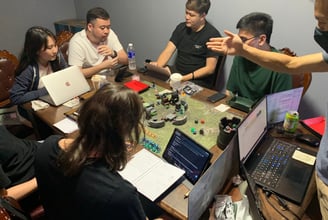
<P><span style="FONT-SIZE: 9pt; FONT-FAMILY: Arial">You need a good playing surface for D&amp;D, and usually, bigger is better. Since everyone has books, miniatures, character sheets, dice, and snacks that they've brought to the table, it never hurts to have a lot of extra space. The session begins after all the players arrive, catch up with each other, and sit down.<o:p></o:p></span></P>
<P><span style="FONT-SIZE: 9pt; FONT-FAMILY: Arial">If you were sitting at the game table with me (RPG Ike) at my Shroud Isle campaign, you could look around and see four or five other people there with you. The table would be covered with a 'battle-mat,' which is a grid-covered erasable surface that can be rolled up. I would have a stool or extra chair beside me with the rulebooks close at hand, my "dice-corral' in front of me (one of those old wooden salad bowls from the 70s), and, rarely, a DM screen in front of me that serves to hide my rolls or selected miniatures from the other players so as to give nothing away.<o:p></o:p></span></P>
<P><span style="FONT-SIZE: 9pt; FONT-FAMILY: Arial">Eventually, I would kick off the session by recapping what happened last session, just to remind everyone at the table about the adventure they're on, and any important developments. I'd go on to describe exactly where the PCs are now--something like "you've just cut down the last of the royal hive guards, but you hear other giant bees scrabbling through the hive towards your location. Baldred is badly injured, but otherwise you're all okay. You still haven't located the missing villagers, but from somewhere above you hear pained moaning in familiar voices. What do you do?"<o:p></o:p></span></P>
<P><span style="FONT-SIZE: 9pt; FONT-FAMILY: Arial">Then I guide the scene. Perhaps someone moves to heal the injured dwarf, Baldred, who was poisoned by the royal guards at the end of the previous session. They might use a magic healing spell that would succeed automatically at curing some hit points or slow the poison's effects--in this case the player simply states that he casts Cure Light Wounds or Slow Poison on Baldred. Maybe the best they can do is rip up a cloak and use the strips to bind his wounds (so I'd call for an improvised heal skill check). <o:p></o:p></span></P>
<P><span style="FONT-SIZE: 9pt; FONT-FAMILY: Arial">The PCs would then move on with their quest, moving deeper into the hive and probably encountering more enemies. If the quest was time-sensitive, like in this situation with the villagers captured by giant insects, I would probably try to underscore that fact by having the PCs hear a scream from within, or maybe signs and sounds of struggling as the captives fight back. Or, one of the PCs who knows something about nature could roll a knowledge skill check and ask me if they think it's likely that the captured villagers are simply going to be eaten, or if they'll survive for a time without the intervention of the PC heroes. As the DM I could simply make a judgment based on the campaign, based on what I know about insect ecology, or based on what I read in the Monster Manual about giant bees.<o:p></o:p></span></P>
<P><span style="FONT-SIZE: 9pt; FONT-FAMILY: Arial">Regardless of the information I present to the players, though, it's up to them to decide what their characters do. They might decide that they need to rest before pressing on, in which case they would probably either leave the agitated hive, or find an easily-defensible area inside where they can post a watch in shifts as they sleep. They might even shrug their shoulders and set fire to the base of the hive, hoping to simply burn the whole thing down with "acceptable" losses, although few true heroes would opt for such a route unless there were no other options.<o:p></o:p></span></P>
<P><span style="FONT-SIZE: 9pt; FONT-FAMILY: Arial">As the session goes on, players eat, drink, make jokes, take breaks, take phone calls, and chat about other things. We look up rules, argue about their interpretation, and curse or cheer at each other for stupid or heroic actions. Maps are drawn, erased, and drawn again as we move from room to room. Conversations are had with characters of all sorts, and those iconic D20s are rolled, again and again, as swords and axes fall, arrows and crossbow bolts and sometimes bullets fly, and the PCs dive away from exploding fireballs and over pit traps filled with spikes.<o:p></o:p></span></P>
<P><span style="FONT-SIZE: 9pt; FONT-FAMILY: Arial">As the PCs succeed I reward them with experience points, treasure, and the built-up relationships with the other characters in the game world. In the previous example with the giant hive, the villagers would be rather grateful for being saved, and the PCs might find their drinks and food bought for them whenever they visit that village and those that neighbor it. Smiths might sell them cheaper weapons, or teamsters might offer to carry their goods for them on their next journey. Their renown grows along with their accomplishments, which may attract the eyes of other groups of adventurers, the ruling classes, angry intelligent monsters looking for revenge, or even the Gods. The DM adjudicates all of this, and a good DM ensures that the actions taken by the players have consequences, good and bad.<o:p></o:p></span></P>
<P><span style="FONT-SIZE: 9pt; FONT-FAMILY: Arial">At its core, D&amp;D is a social experience, and I'd be lying if I said that the people playing didn't treat it much like sitting down for poker night or to watch a hockey game. It can be as clean as you want it to be, but as a young man playing with other men, our games are often rude, crude, lewd, and noisy, but always fun. As the session continues the DM or players will look for a good point to close things down. Some DMs like to end on cliffhangers, and others like to end as the PCs are settling down for a peaceful rest. When a suitable point is agreed upon, the players gather their stuff, chat about the session, plan for a time for the next (for us it's usually 2-3 weeks from then), and say goodbye. </span></P>
<P><span style="FONT-SIZE: 9pt; FONT-FAMILY: Arial">Between sessions the DM and players might trade emails. These could contain feedback about the game, information about the characters, or questions about game features that the players or DM want to modify to suit their game better. The DM starts planning the next session, if he hasn't already, and then we're back to the beginning, except the players are a little more powerful and the story has moved a few pages forward.<o:p></o:p></span></P>
<P><span style="FONT-SIZE: 9pt; FONT-FAMILY: Arial">Hopefully that answers some of the questions you may have had about the structure of the game and the roles of the players and DM. I also hope it alleviates any of the concerns you may have had about the game-related social issues. (If not, please try the U20 FAQ, and if that doesn't have answers to your questions, drop us a line. We'd be happy to discuss the game with you.)<o:p></o:p></span></P>
<P><span style="FONT-SIZE: 9pt; FONT-FAMILY: Arial">Give it a try, and have fun out there.<o:p></o:p></span></P>]]></content></entry><entry><title>Die-Cast Ignorance</title><id>http://www.unnatural20.com/table-manners-latest-article/2008/6/19/die-cast-ignorance.html</id><link rel="alternate" type="text/html" href="http://www.unnatural20.com/table-manners-latest-article/2008/6/19/die-cast-ignorance.html"/><author><name>RPG Ike</name></author><published>2008-06-19T02:33:45Z</published><updated>2008-06-19T02:33:45Z</updated><content type="html" xml:lang="en-US"><![CDATA[<p><span class="sizeLess20"><em>[Note: This article was written in April, 2005, but despite the age and the terrible Sun Tzu quote at the end, it stands up well and largely reflects how I feel about the hobby. - RPG Ike]</em></span></p><p><br />The city streets are all but deserted at 9:30 A.M. on the weekend, and it makes for relaxed driving. If it was entirely up to me it would be earlier still, but the people I&rsquo;m meeting this morning--friends from junior high and high school--like to sleep in a little. I can respect that, so I&lsquo;ll be the one to wake them when I knock on their door. Much of Edmonton is still asleep, or watching cartoons in their pyjamas, or recovering from last night&rsquo;s alcohol binge, but I&rsquo;m moments away from a visit with five friends. What would be worth missing an opportunity to sleep in? </p><p><br />Thirty years ago the creative and entrepreneurial minds of Gary Gygax and David Arneson combined to create an entirely new way of having fun. The innovation of the Dungeons &amp; Dragons&trade; (D&amp;D) pen-and-paper role-playing game beat a path for dozens of inspired products and hundreds of other games that are as varied as the people who make and play them. The game is ageless--it&rsquo;s played by children and adults--and an entire subculture has sprung up around it and the community of people who play. Unfortunately, D&amp;D carries with it some fairly hefty image problems that have made the game a hot topic in the conservative Christian church and elsewhere, image problems that are completely unnecessary and have been propagated through ignorance. I&rsquo;m here to dispell the myths and misconceptions associated with this dice game. </p><p><br /><strong>The Motivation</strong> <br />Unless you play or have played, your knowledge of D&amp;D is probably quite limited. To be honest, I thought D&amp;D sounded a little strange at fist, if intriguing. I mean, come on, people sit around a table, each pretending to be a character while one player is a kind of imaginary referee who tells you what happens? How could that work? Well, it does work. It works so well that D&amp;D is enjoying the height of its popularity with an estimated 20 million players worldwide. It works because it&rsquo;s fuelled by imagination and fun. I got into the game rather quickly, and seven years later I&rsquo;m more enthralled by the whole experience than ever before. </p><p><br />However, I soon learned that being enthusiastic about D&amp;D isn&rsquo;t quite the same as being enthusiastic about, say, cars, computers, snowboarding, or even getting drunk. I have encountered articles citing that D&amp;D is evil, and that playing it is the first step towards drugs, violence, and eternal damnation. I have endured a lot of teasing, good-natured and not, about my hobby. Eventually, I started hiding the fact that I played, and while I never contributed directly to the stigma and prejudice attached to people who play D&amp;D, my eventual silence did nothing to dispel it. Enough is enough. </p><p><br /><strong>The Game</strong> <br />I should clarify what happens when you play. In a session the players and Dungeon Master (DM), a.k.a. the referee, gather around a table with their papers, dice, and pencils. The DM sets the scene, often by reminding the players where they were the last time they finished playing. Then the players react to that scene, generally attempting to stay true to the character they created when they began. Conversely, the DM then tells the players what their actions have caused, and the game progresses. Sometimes pictures are drawn or objects representing the players or monsters are moved around to illustrate the action of the story. The dice are rolled when a character tries to do something that requires some kind of skill, and the roll determines the character&rsquo;s success. Like any RPG (role-playing game), such as Morrowind, Final Fantasy, or Neverwinter Nights videogames, to be successful you have to learn the rules of the game and learn to work with the other characters or players to combine talents. As a DM, you control the world the players are in, including all the people that inhabit it, with the exception of your players. Because of this the referee must have a firm grasp of the rules of the D&amp;D world. </p><p><br />Since you can play out anything that your character can hypothetically do, D&amp;D is a varied game offering many different thinking activities and requiring a range of skills that few other hobbies can match: math with every roll; reading of the rule books and character record sheets; problem solving as the DM places obstacles; imagination to &ldquo;see&rdquo; the action of the story; strategy in every encounter and in character creation; and social interaction with the other players and characters within the story. It also requires a good deal of desire to play, since players are often trying to find several hours together when they can meet--you can&rsquo;t really play D&amp;D alone, and the experience is best when shared with four or five of your friends. There is nothing clandestine about these meetings. </p><p><br />While this may or may not sound appealing to you, my experience with the game has me believing that it&rsquo;s certainly not worthy of ridicule or fear. Where then does D&amp;D&rsquo;s reputation come from? I went to other players for answers. </p><p><br /><strong>The Image</strong> <br />It&rsquo;s clear to me that D&amp;D suffers from two major image problems--that of a violent, drug-promoting, and wholly evil activity, and that of the male adolescent shut-in&lsquo;s favourite pastime. Often it is Christians who have difficulty accepting D&amp;D as only a game, so I was surprised when I met a Christian who not only played the game, but supported it for its Christian potential. Mark J. Young is a bible scholar and Chaplain of the Christian Gamers Guild. He has been playing D&amp;D and many other pen-and-paper role-playing games for over 20 years. He argues that the believed &ldquo;evil&rdquo; aspect of the game is the smaller issue and that stereotypes are the main problem. &ldquo;Many people have the association in their minds that the D&amp;D players they knew were all high school kids (because they were in high school when they knew them). Most of them were boys, because boys dominate the hobby, and adolescent boys who are not in the popular crowd generally have much trouble socially with girls.&rdquo; Mark goes on to say that the games available at the time were rules-heavy and appealed most to more intellectual and less socially-oriented people--&ldquo;geeks&rdquo; by most standards. </p><p><br />Simple enough, but how has this image survived? Certainly, the &ldquo;geeks&rdquo; of today&rsquo;s world are some of the wealthiest, most talented, and articulate people there are. Peter Jackson has become a geek god with his realized vision of the Lord of the Rings movies. Steven Spielberg and Bill Gates are examples of successful geeks, and Vin Diesel, action hero, has recently admitted to being an avid D&amp;D player. People from all walks of life and backgrounds play, like Johnn Four. Four is a writer and web site developer who was introduced to Dungeons &amp; Dragons&trade; when he was nine. He currently fills an envy-inducing position at Edmonton&rsquo;s Bioware Corp., one of the leading computer and console videogame developers in the world. Johnn also DMs regularly, saying that in addition to the skills that all players require, DMs also need &ldquo;basically the same skills that are required to run a good business meeting: organization, clear communication, listening, and facilitating.&rdquo; </p><p><br />&ldquo;D&amp;D is a very social and interactive game,&rdquo; says Four. &ldquo;The game is complex and requires a lot of thought, much like chess, and its free-form nature makes imagination and social participation important.&rdquo; It should be no surprise that a large part of every game is simply catching up and goofing off with the other players--D&amp;D is one of the more personal social activities you can experience, offering much more quality personal interaction than watching a movie or going to a noisy bar. You learn a lot about the other players. Four says that &ldquo;if the people who come over to my house aren&rsquo;t friends at the start of a D&amp;D campaign because we haven&rsquo;t met yet, they definitely are by the time we finish.&rdquo; Finding a good group to play with can also be tricky, and many DMs will initiate a pseudo-interview, where they can have coffee with a player and learn who that player is and what their interests are related to gaming and the world. </p><p><br />Unfettered imagination, social participation, and meeting new people are pretty attractive concepts that are not often associated with D&amp;D. It&rsquo;s possible that the image problems have survived simply because D&amp;D players, like myself, have let them survive by being quiet. Johnn Four doesn&rsquo;t believe that D&amp;D has an image problem because &ldquo;in recent years the general public has learned a lot more about what the game is due to the popularity of fantasy movies, such as Lord of the Rings, and explanation and mention from celebrity D&amp;D players.&rdquo; </p><p><br />Indeed, why should D&amp;D players hide that they like the game? The guys I normally play with are forward-thinking, responsible people. Most of them are students like myself, entering the career workforce and improving our communities in our own way (for instance, I volunteer with Big Brothers and Big Sisters). Yet we find ourselves under regular attack by family members and friends, to say nothing of our efforts to hide the hobby altogether. If we were all golfers or hunters or stamp collectors we&rsquo;d seldom have our interests questioned. Perhaps in answering these questions we are validating the doubts about the &ldquo;appropriateness&rdquo; of D&amp;D, which is unnecessary in itself; why should anyone need to prove that their hobby is &ldquo;appropriate&rdquo;? Chaplain Young explains that &ldquo;as far as I am concerned, no charge has been brought against D&amp;D that has not been answered, and the charges themselves are patently foolish in the main.&rdquo; </p><p><br />D&amp;D has many qualities that are especially beneficial to youth. The game can be a release from the hassle of teenage life, much like a good book except you read this one with your friends and participate in deciding the plot. It teaches social skills, conflict management, and encourages cooperative play. It teaches consequence, as the DM changes the course of the story as the players&rsquo; characters take actions. And D&amp;D players read every session; there&rsquo;s always a rule that needs to be looked up, or a description read, or fact-checking done by all parties. Playing D&amp;D often leads to a greater interest in reading fiction, particularly from the fantasy, science fiction, and adventure genres. </p><p><br />Edmonton student Dave Schaefer has been playing D&amp;D for about nine years, and he too expounds on D&amp;D&rsquo;s virtues in regards to its role in a young person&rsquo;s life. &ldquo;D&amp;D can be a stable activity. It means [youth] are not out doing drugs or vandalizing things, though I admit most kids don&rsquo;t go to those extremes.&rdquo; Dave&rsquo;s suggestion opens up an avenue that few people have explored--using D&amp;D as a tool to educate. Chaplain Young embraced the concept around 1980 when he and his wife originally heard about D&amp;D being used as a group therapy technique for teenagers. They saw the game&rsquo;s potential &ldquo;to create adventures like some of those in our favorite Christian fiction.&rdquo; Young ran games at his house, using D&amp;D to introduce people to the gospel. Shortly thereafter, he mentioned D&amp;D during a radio broadcast at the small Christian station where he worked for five years, and he discovered that many Christians believed that the game was evil. Fortunately, Young examined the evidence that was brought against D&amp;D and found it insubstantial. He went as far as to write an article on the subject entitled &ldquo;Confessions of a Dungeons and Dragons &trade; Addict.&rdquo; This article is still considered as one of the main proponents of D&amp;D despite its age, and can be read at <a href="http://www.mjyoung.net/dungeon/confess.html">http://www.mjyoung.net/dungeon/confess.html</a> .</p><p><br />I wish that I had known about the article only a few months ago, when I had the opportunity to introduce D&amp;D to a younger friend of mine. However, I felt it was best if he discussed it with his mother before we actually played. She decided that it was a bad idea, and I later discovered that it was because she had gone online and found an article detailing a youth&rsquo;s quick descent from a god-fearing, respectful Christian to a drug-abusing demon-worshipper. The article cited that D&amp;D had precipitated the youth&rsquo;s change, and with the official backing of the internet, who could blame her for deciding accordingly? Well, I could, of course--the story was ridiculous. </p><p><br />&ldquo;...A concerned parent who begins to research the question of whether he or she should be concerned about a child playing D&amp;D will find many resources warning them of the horrible consequences of playing such a game.&rdquo; Chaplain Young says. Most of the negative opinions come from people who have never played the game. Young also explained to me that, among other objections, there are three main problems that conservative Christians generally have with D&amp;D: violence and the promotion thereof; polytheism; and the presence of magic in most D&amp;D games. </p><p><br /><strong>The Violence</strong> <br />I don&rsquo;t mean to glorify the concept, but violence is all around us. In playgrounds, on the news, in movies, on television, and at home. No, this doesn&rsquo;t make it okay--I don&rsquo;t approve of violence being shown to children or done to anyone. Humans are violent by nature, especially children who haven&rsquo;t yet learned how to control themselves. D&amp;D can be used to teach kids about violence, or at the very least can give them a release other than lashing out at teachers, parents, siblings, or other students. As Chaplain Young points out in &ldquo;Confessions of a Dungeons and Dragons&trade;Addict,&rdquo; many daily activities, particularly sports, are violent. People arguing that D&amp;D promotes violence do not understand that the players are not themselves being violent; they are sitting at a table with friends. </p><p><br />&ldquo;As a sane and well-balanced thinking person I am perfectly capable of drawing the line between fantasy and reality,&rdquo; says Schaefer. He goes on to say that often D&amp;D players already read novels or write stories of their own and &ldquo;people who enjoy doing that have no troubles keeping what is real separate from what is not.&rdquo; </p><p><br /><strong>The Gods (Polytheism)</strong> <br />The average D&amp;D setting, much like pantheons of many older human civilizations like the Greeks, Romans, and Egyptians, outlines many different gods or god-like creatures that fill similar roles, much to the chagrin of conservative Christians. This is done as a game mechanic to represent clear lines of good and evil, and to allow players more creative choices as the god worshipped has an effect on the character&rsquo;s moral outlook and personality. </p><p>Understandably, seeing a friend of yours or your own children talking about the worship of a D&amp;D god as a character could be a little alarming, but this takes us back to the issue of keeping fact separate from fiction. While worship of multiple gods is at odds with Christian religion, that doesn&rsquo;t stop grade schools from teaching children about the ancient Greeks or Romans, as it shouldn&rsquo;t. In fact, if the players and DM were interested, they could create a campaign that was set in one of these real-life ancient settings to teach the players about what went on. The basic D&amp;D game already includes many features inspired by human mythology, particularly the monsters like the minotaur, griffon, and hydra. Scott Kurtz of <a href="http://www.pvponline.com/">www.pvponline.com</a> has written an article (he calls it a rant) entitled &ldquo;Five Reasons Your Kids Should Play Dungeons and Dragons&trade;.&rdquo; The fifth reason is that you can play it with your kids, and as Mark Young can attest, you can reach and educate a lot of people about a variety of topics, like religion, through the game. Kurtz&rsquo;s article can be read at <a href="http://www.pvponline.com/rants_dd.php3">http://www.pvponline.com/rants_dd.php3</a> .</p><p><br /><strong>The Magic</strong> <br />One of the most contentious issues surrounding D&amp;D, magic is also the most misunderstood. The assumption with the use of magic in the game is that the players themselves learn incantations and perform the action of &ldquo;casting&rdquo; a spell. That isn&rsquo;t what happens. A player simply says &ldquo;I cast this spell.&rdquo; There are many magic spells in the D&amp;D rulebooks, and they do have an entry in their description that explains whether the character says something, moves in some way, or needs some object to make the spell function. In no case does the spell describe the movements or the incantation, and rarely does it explain that the object &ldquo;must be eaten,&rdquo; or thrown into the air,&rdquo; or what have you. Also, the description of the spell is of the spell&rsquo;s effects only. For instance, &ldquo;burning hands&rdquo; causes a sheet of flames to spring from the caster&rsquo;s hands. It causes X amount of damage. It can be guarded against like so, etc. As Chaplain Young puts it &ldquo;players no more cast spells in Dungeons and Dragons&trade; than shoot each other with revolvers in Boot Hill&trade;.&rdquo; (Boot Hill&trade; is another pen-and-paper role-playing game, but the argument can be made with too many other games to count). </p><p><br /><strong>The Rest</strong> <br />Much like some hard rock musicians, D&amp;D has been charged with making its players suicidal, even as there has been no proven relationship between playing D&amp;D and committing suicide. D&amp;D has been charged with promoting evil because it&rsquo;s easier to play an &ldquo;evil&rdquo; character--one who would go to any length for personal gain or gratification--than a good character. In every game I have ever played this is the opposite of the truth. During character creation in D&amp;D you are required to choose an &ldquo;alignment,&rdquo; which is a qualitative measure of your character&rsquo;s morals and attitudes. A character performing an evil act will quickly feel the consequences, perhaps through in-game law enforcement (the evil character is sought out by the local militia to answer for his crime), or through shunning (the character&rsquo;s moral party members may force him out of the group or turn him into the authorities). &ldquo;Good&rdquo; characters performing evil actions face all the same consequences, with the added loss of many of their special abilities that require them to be lawful and fundamentally good. A well-played D&amp;D world reflects real-world consequences for immoral decisions. </p><p><br /><strong>The Alternative(s)</strong> <br />If you are still unconvinced, then please realize that Dungeons &amp; Dragons&trade; is a versatile game system. The average session usually includes some role-playing with townsfolk or between characters, some wandering, some random encounters with dangerous creatures, and some recuperation. However, if you were so inclined, your DM could design a whole game world where magic didn&rsquo;t exist, where there was one Christian god, and where the players were encouraged to avoid violence or even penalized if they did violence. And while D&amp;D is an identifiable father figure of RPGs, it is one of hundreds of other excellent games out there today. &ldquo;The independent publishing movement in the hobby game industry is flourishing,&rdquo; says Chaplain Young. &ldquo;Treating D&amp;D like it was the entirety of the hobby is detrimental to everything, including D&amp;D.&rdquo; </p><p><br /><strong>The Verdict...</strong> <br />...is entirely up to you. Sun Tzu wrote in &quot;The Art of War&quot; that &quot;if you know the enemy and know yourself you need not fear the results of a hundred battles.&quot; While lines of battle may not have been drawn, pen-and-paper role-playing games like D&amp;D offer so many benefits that anyone who is interested owes it to themselves to make an educated decision by knowing both sides of the issue. Schaefer sums it up for me: &ldquo;D&amp;D is a good pastime because it&rsquo;s fun to do while still being clean and healthy. It gets friends together. It lets people use their imaginations to create a world and tell a story. It lets people be heroes.&rdquo; </p><p><br />With college, work, and other responsibilities all vying for my spare time, I look forward to squeezing in a few hours for D&amp;D more than ever. Its creative nature, the role-playing, and the epic battles appeal to me on every level. </p><p><br />Happy 30th, Dungeons &amp; Dragons&trade;. Here&rsquo;s to smoother roads.</p><p><br />&nbsp;-30-</p>]]></content></entry></feed>